Your event will not be judged on the keynote. It will be judged on the transition.
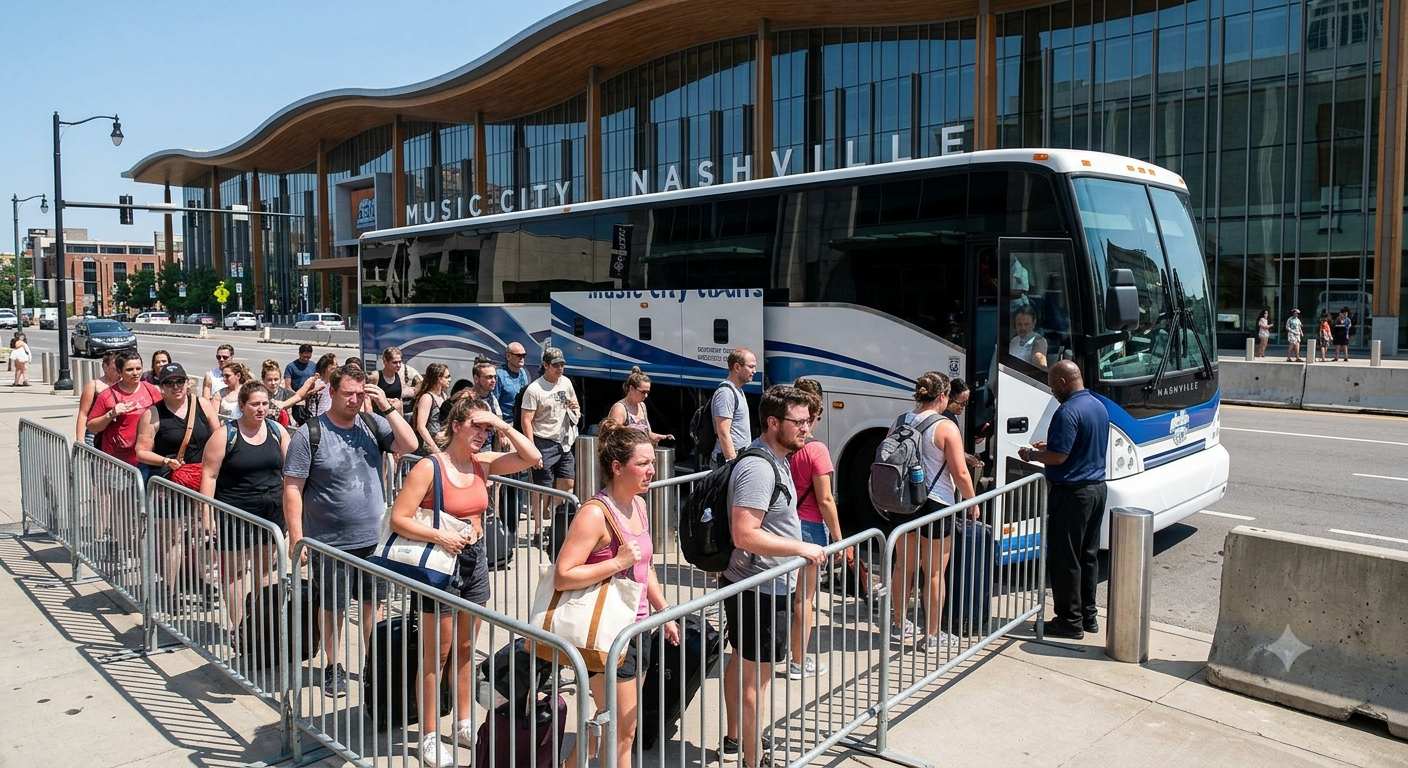
Everything you planned goes right, and then two hundred guests are standing in the July sun, pouring sweat, watching a bus load one person at a time. That’s the twenty minutes your client remembers. That’s the story they tell on Monday.
There’s a better way to move people across downtown Nashville, and it’s been rolling past you on Broadway this whole time.
Your Guests Leave When They’re Ready. Not When the Bus Is Full.
Here’s the structural problem with a bus, and it has nothing to do with the quality of the bus.
A motorcoach is a batch process. Nothing moves until everything is loaded. On average, with everything it takes, loading a motorcoach runs about fifteen minutes, and during those fifteen minutes, fifty people are waiting on the slowest three. The guy closing out his tab. The two VPs mid-conversation. The person who went back for a coat.
Which means your most senior guests are being made to wait on your least punctual ones, in front of each other.
A pedicab fleet is a stream. Each cab leaves the second its guests are seated. Six people, under a minute, rolling. The next cab pulls forward. Nobody waits on anybody.
For a corporate program, that difference is the entire ballgame:
- Want to network thirteen minutes longer? Do it. The whole room isn’t idling at the curb on your account.
- Your CEO never stands on a sidewalk waiting for a headcount.
- Guests move on their own timeline instead of being herded onto someone else’s.
- On a continuous loop, departures never stop. There’s no “next bus at 8:15.”
And when you do want everyone moving at once, whether that’s a wedding party, a group photo, or a synchronized arrival, we stage the full fleet and roll together. That’s a choice you get to make, not a constraint the vehicle imposes on you.
On a short downtown loop, our in-house fleet moves roughly 400 guests per hour at peak. Longer routes lower that number, since distance is the only real variable, and for large-scale activations we bring in partner operators and scale into the thousands per hour.
Here’s the distinction your client will feel even if they never put words to it: each small group rolls out on its own clock and walks into a room that’s ready for them. Your guests never wait on the room. The room waits on them.
One Fleet, Every Address
Now the problem every convention planner knows by heart: your attendees are not all staying in the same place. Guest stay citywide, and Music City Center books room blocks across half of downtown.
That one program scatters guests across the Omni Nashville, the JW Marriott, the Renaissance, the Grand Hyatt, and the Westin, plus the local attendees who drove in and parked in a garage four blocks the other direction.
A bus doesn’t solve this problem well. It runs one route with fixed stops, which means every guest rides the entire loop regardless of where they’re going. The person staying at the last stop sits through everyone else’s hotel. To minimize this, you can add a second route, and you’ve doubled your cost to cut the pain in half.
We don’t run a route. We run destinations. Ten cabs leaving the same venue exit can go to ten different addresses in the same minute. Your Omni guests go to the Omni. Your JW guests go to the JW. Your local VP who drove in gets dropped at their garage door, not at a hotel three blocks from their car.
Nobody rides past their own bed to accommodate somebody else’s.
This is at its most valuable at the end of the night, when a reception breaks and two hundred people need to be in a dozen different places. That’s the moment a bus program turns into a queue and a pedicab fleet just quietly empties the room.
Nobody Ever Felt Important Boarding a Bus
Let’s say the quiet part out loud: there is no luxury motorcoach.
There are nice ones, the new ones with leather and wifi and a good sound system. The problem is that every single one of them is still a bus, and every guest who steps onto one knows exactly what’s happening. They are being transported, efficiently, in a group, like cargo.
You cannot spend your way out of this. A $3,000 coach and a $1,200 coach deliver the identical emotional experience, which is none.
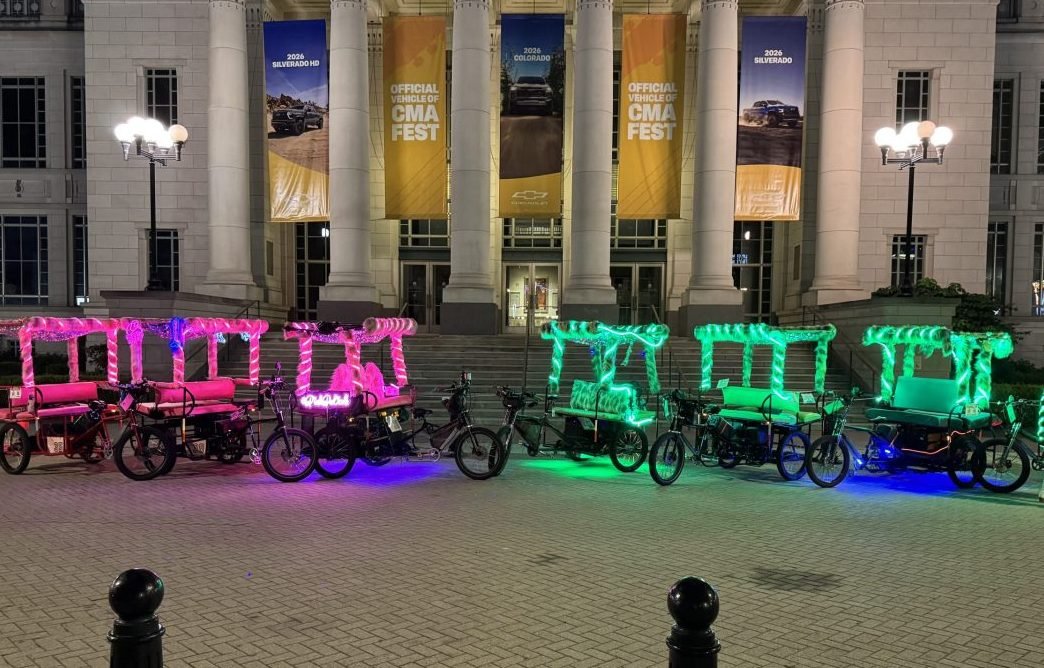
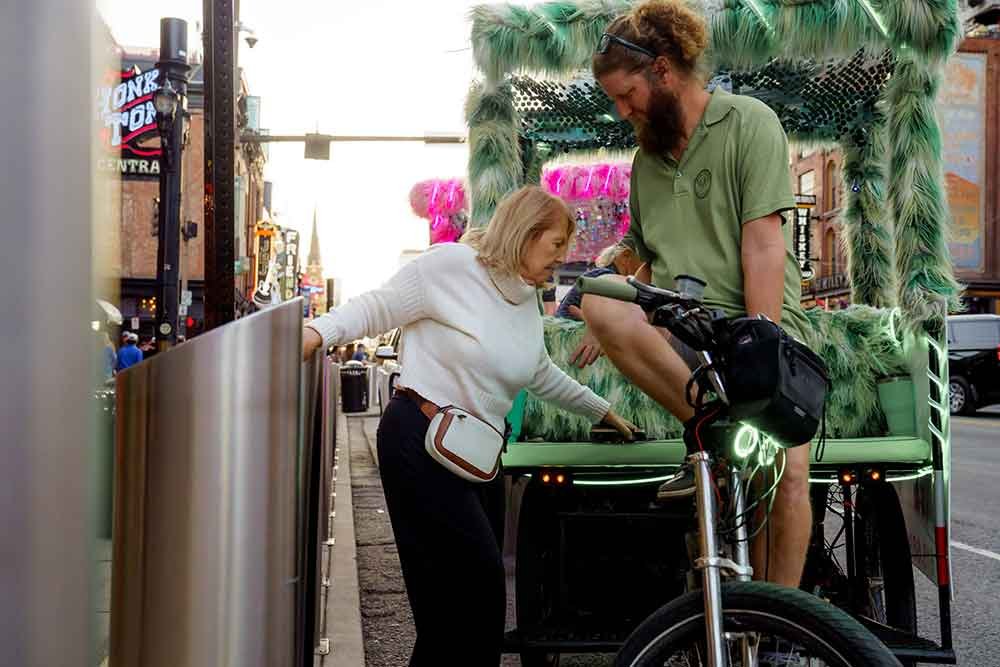
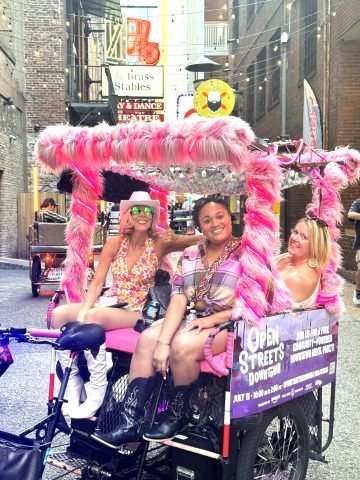
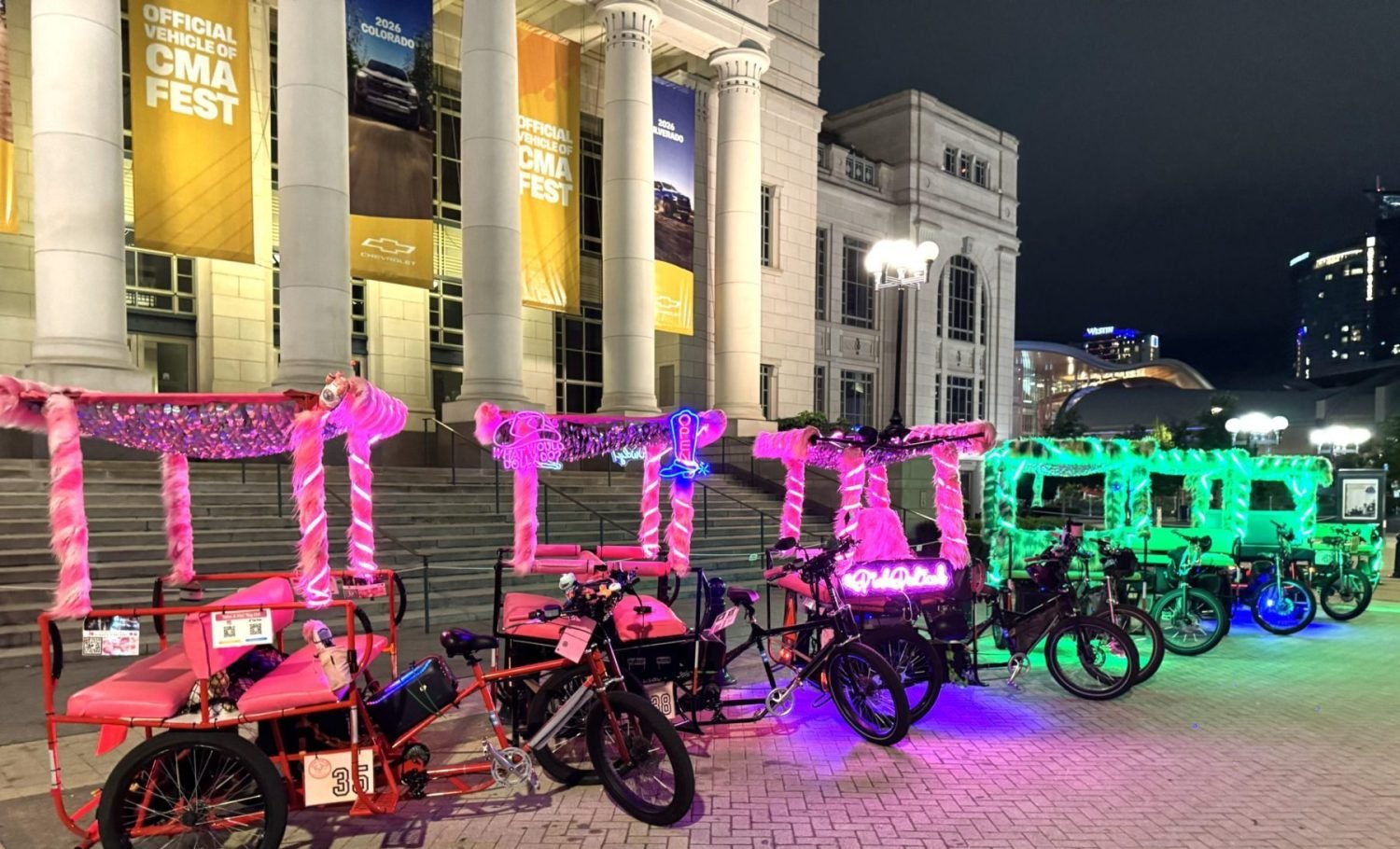
Riding a pedicab down Broadway is a completely different transaction. You’re open-air. There’s music playing. Every person on the sidewalk turns and looks, because our pink and green cabs are impossible not to look at. For six or eight minutes, your client’s guests are the most interesting thing happening on the busiest street in the South.
There’s a reason people pay real money for a spot on a parade float. It isn’t transportation. You could walk the route faster. It’s the few minutes of being the thing everyone else is watching. That feeling is worth a lot, and it’s almost impossible to buy.
Our guests get it on the way to dinner.
And while they’re getting it, your sponsor’s logo is riding on the panel beside them, in front of the thickest foot traffic downtown. Your transportation line item quietly starts doing marketing work.
The Permit You Can’t Get in Time
You already know downtown needs permits. That isn’t the problem.
The problem is that your client just moved the closing reception, it’s Wednesday, the event is Friday, and there is no version of Metro’s permitting process that moves that fast.
Downtown Nashville is not built for motorcoaches. Most blocks between Broadway, SoBro, and the Gulch have no legal place for a 45-foot bus to sit and load. When a bus stops in a travel lane to board guests, it isn’t a gray area. It’s an obstruction of the public right-of-way, and it requires a permit from the Nashville Department of Transportation.
Per Metro Nashville’s published permit schedule, a lane closure or street closure permit runs $55 for up to five days, with a violation fee of $50 per violation per day if you have a permit but don’t follow it. Parking in a loading zone longer than the Traffic and Parking Commission allows is a separate $15 per day per location per vehicle permit, with a $45 violation fee. Skip the permit entirely and the fee triples to $165.
The fees aren’t really the issue; they are just another step to squeeze into your busy day. The calendar is.
All right-of-way permits go through the city’s ePermits system and are reviewed on the city’s timeline, not yours. Depending on the closure, you may also need a template from Metro’s Traffic Control Guidelines, or a stamped traffic control plan from a licensed engineer for anything running longer than seven continuous days. There is no expedited lane for a Wednesday request about a Friday event.
Which leaves you choosing between telling your client no and gambling that nobody writes a citation in front of their guests.
Pedicabs take that decision off the table. We’re narrow, we’re licensed to operate on these streets, and we stage curbside without closing a lane. No right-of-way permit for your client to pull, no traffic control plan to submit, no city review window, and nothing to gamble on. A change that lands Wednesday can roll Friday.
The Cost Conversation
Planners assume the fun option costs more. Run the actual structure before you accept that, because the two models bill in completely different ways.
How we bill: hourly, per bike, driver included. No separate driver fee, no fuel surcharge, no parking, no staging charge. Our minimum for corporate work is one hour, which is also how we recommend booking a rolling shuttle: one hour of continuous dispatch, cabs leaving as guests are ready.
How a bus bills: hourly or daily, per vehicle, with a three- or four-hour minimum on most contracts. Charter bus rentals in Nashville typically run $180 to $325 per hour, or $1,700 to $3,400 per day, depending on vehicle size, duration, and routing. Premium coaches from some operators quote well above $500 per hour.
Put those side by side on a real job: a twenty-minute transfer for 120 guests between a downtown hotel and a reception venue.
The bus version
You need two 56-passenger coaches. At $275 per hour against a four-hour minimum, that’s roughly $2,200 in vehicle time, plus:
- Driver gratuity, commonly 15 to 20 percent
- Venue or hotel staging and parking fees
- A right-of-way or loading zone permit, if the route requires one
Call it $2,600 and up. And those coaches are in motion for about forty minutes of the four hours you paid for. You are renting parking.
The pedicab version
Eight bikes, one hour, drivers included. Same 120 guests, same twenty-minute window, and the meter stops when the transfer does.
Usually less than half the cost. Ten times the fun.
You size the fleet to the headcount instead of stretching the clock: more guests means more bikes inside the same billing window, not more hours.
For groups under 400 guests, we come in lower than a comparable bus program nearly every time. Above that, send us the numbers and we’ll tell you straight which way the math falls.
That’s the whole structural difference. A bus makes you buy hours you won’t use. We let you buy the hour you actually need and scale sideways with bikes.
What We Actually Handle
We’re not a novelty add-on. We run as your transportation vendor:
- Convention and conference shuttling: Music City Center to downtown hotels, continuous loops on your agenda
- Multi-hotel dispersal: simultaneous point-to-point drops across every property in your block
- Corporate event and offsite transfers: dinners, receptions, team activations
- DMC and destination program support: we work directly with your operations team, not around it
- VIP and executive guest transport: small-group, door-to-door, no waiting
- Game day and arena transfers: Nissan Stadium, Bridgestone Arena, Ascend Amphitheater
- Branded fleets and sponsor activations: full wraps, custom signage, and impression reporting
- Last-minute and same-week bookings: the reason most planners call us the first time
You name the route and the headcount. We’ll tell you the fleet size, the staging plan, and the timing.
Accessibility
Our current fleet is not wheelchair accessible. When your program includes guests who need accessible transportation, we coordinate directly with partner operators to cover it as part of your plan. Tell us at booking and we’ll build it into the routing rather than leaving you to source it separately. ADA-accessible pedicabs are in development for our own fleet.
End the Night on the Right Note
You planned a great event. Don’t let the last impression be a line on a sidewalk.
Send us your route, your date, and your headcount. We’ll come back with a fleet plan and a quote, usually within 24 hours, and often the same day when you’re up against it.
Nashville Bike Taxi: event transportation for conventions, corporate events, and destination programs across downtown Nashville.
Get A Quote