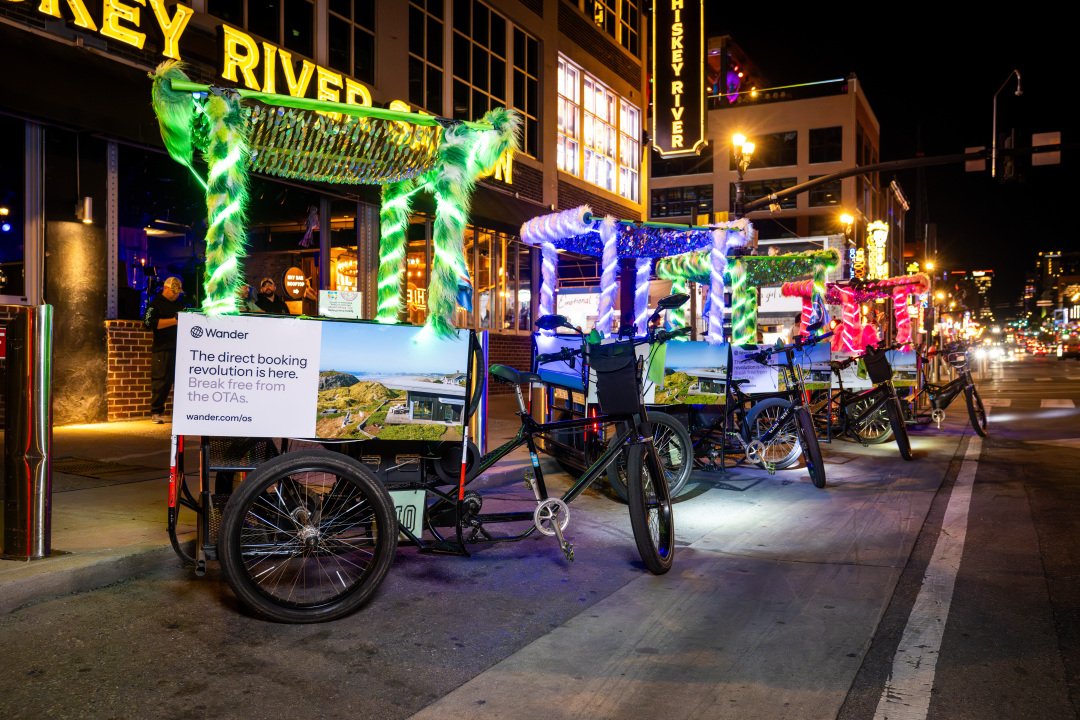
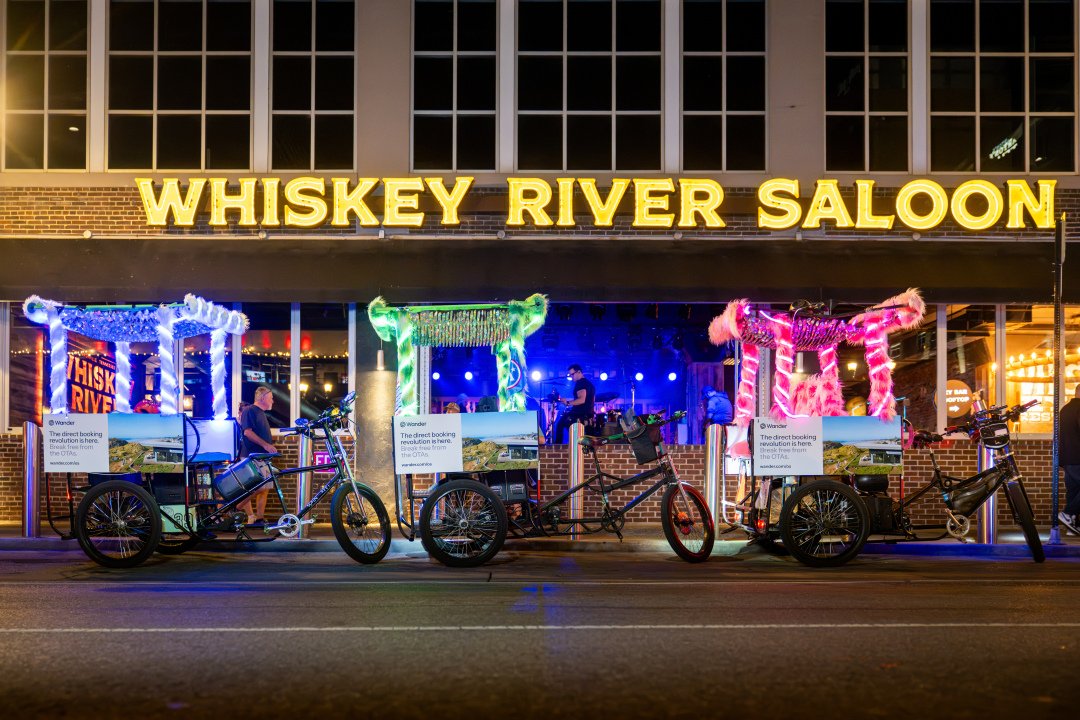
Picture this: a neon-lit Friday night on Broadway, hundreds of tourists spilling out of honky-tonks, phones raised and ready. A wrapped pedicab rolls through the crowd, and suddenly it is not just a ride. It is a photo opportunity, a shareable moment, and a brand impression happening all at once.
That is the quiet power of mobile billboard advertising in Nashville’s entertainment district, and it is something static outdoor boards simply cannot replicate.
In this post, we are going to break down exactly why Nashville Bike Taxi wraps have become the most-photographed ad platform on Broadway. We will look at what makes this environment so uniquely valuable for brands, how the numbers stack up against traditional outdoor advertising, and why earned social impressions turn a single wrap into a multiplier for your paid reach. We will also get into the practical side, covering what great creative actually looks like on a pedicab and how brands are using this platform beyond a simple logo placement.
If you are thinking seriously about advertising in Nashville, this analysis will give you a sharper way to evaluate your options.
Broadway Is Not Your Average Advertising Environment
Nashville pulled in 16.8 million visitors in 2023, and Lower Broadway sits at the center of nearly all of it. That is not a typical outdoor advertising audience. It is one of the densest concentrations of engaged, slow-moving, camera-wielding pedestrians you will find anywhere in the country.
The people walking Broadway on a Friday night are not commuting. They are celebrating. Tourists, celebrating groups, and out-of-towners documenting every block of their trip make up the bulk of that foot traffic, and every single one of them has a phone out. That mindset, already primed for stimulation and sharing, means branded visuals get captured organically at a rate that simply does not happen on a highway or a transit corridor.
Here is the challenge that static boards face in this specific environment: when the street is competing with live music spilling out of a dozen bars, neon signs on every facade, and the general spectacle of the entertainment district, a fixed sign above the action becomes part of the wallpaper. Eyes are drawn to movement, novelty, and things happening at ground level, not to vinyl stretched across a wall fifteen feet up.
Street-level advertising on Broadway operates on a different set of rules entirely. The audience is not moving at 55 miles per hour with a half-second glance to spare. They are strolling, stopping, and looking around for the next interesting thing to photograph. That is a fundamentally different opportunity, and it rewards formats built for engagement rather than formats built for a quick drive-by impression.
What Makes Mobile Billboard Advertising Actually Work
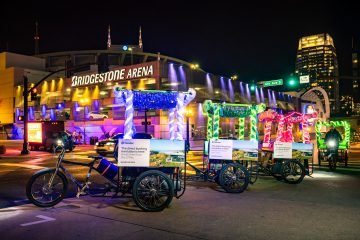
So what’s actually driving the performance gap between mobile advertising and its static counterparts? The short answer is movement, and it matters more than most advertisers realize.
Research has shown mobile campaigns generating roughly 27 times higher response rates than traditional internet banner campaigns. That figure comes from the digital channel world, but the underlying principle applies just as cleanly to street-level formats. Movement naturally draws the eye, it is a basic feature of human attention, and a wrapped pedicab threading through a crowded block puts that to work at street level. You look. You can’t really help it.
That reflex is only part of the advantage. A static billboard delivers one exposure per person who walks past it. A mobile platform moving through the same environment creates fresh impression opportunities with every block, every crowd, and every new cluster of people it passes. The math compounds fast on a busy Friday night.
The deeper strategic advantage is context. Mobile billboard advertising puts a brand physically inside the environment where the target audience is already spending money and making decisions. That is fundamentally different from a sign on the perimeter of the entertainment district, or a digital ad served to someone who might be anywhere. Proximity to the point of decision is one of the oldest principles in marketing, and a pedicab working the Broadway and Lower Broadway corridor is as close to that point as any format can get.
For brands focused on this specific audience, the difference between being inside the zone and adjacent to it is not a minor detail. It is the whole game.
The Photography and Sharing Flywheel: Earned Impressions You Did Not Pay For
Movement gets you seen. What happens next is where the real value compounds.
When a fully wrapped pedicab rolls down Broadway on a Friday night, people pull out their phones. Not because they feel obligated to, but because it is genuinely fun and visually striking. Passengers snap selfies with the branding right behind them. Bystanders grab a quick video. A bachelorette group tags their location and posts the whole thing before the ride is over. That behavior creates a stream of user-generated content that keeps working long after the pedicab turns the corner.
Every one of those posts carries your brand into social feeds populated by people who were nowhere near Broadway that night. That is the earned impression layer, and it stacks directly on top of the paid placement with no additional spend required.
Visually novel, location-specific content tends to drive stronger engagement than generic branded content. A pedicab qualifies on both counts: it is unusual, it is tied to a specific place and moment, and it looks good in a photo. A flat vinyl wrap on a parked truck does not clear that bar, which is why it rarely ends up in anyone’s vacation album.
The math for earned media is simple. Every organic share is an impression that costs nothing incremental. On a busy weekend night, a well-wrapped pedicab moving through the crowd creates a steady stream of those organic posts just by doing its job.
The Cost-Per-Impression Math That Makes Outdoor Advertisers Pay Attention
All those earned impressions stack beautifully, but they also change the underlying math in a way that’s worth spelling out for anyone allocating an outdoor advertising budget.
A premium static board in a high-demand entertainment district isn’t cheap. Nashville is a competitive advertising market, and high-demand entertainment corridors like Broadway carry the location-based price premiums typical of major destination districts. The trade-off is straightforward: you pay for visibility at one fixed point, and your impression count is entirely dependent on how many people walk or drive past that single location during the campaign window.
A pedicab wrap operates on a different model. One vehicle moving through multiple blocks, stopping at busy venues, circling the corridor for several hours in a single evening reaches a genuinely different pool of people at each stop. The cost doesn’t multiply with the geography; the audience does.
Combined with the earned social impressions described above, the effective CPM drops considerably below what any fixed placement in the same corridor can match.
For brands thinking about advertising in Nashville, TN, that blended CPM is the number worth focusing on. A single-channel static placement delivers reach. A dynamic street-level platform delivers reach, earned media, and direct audience engagement in the same campaign, simultaneously.
If your goal is both awareness and interaction, a platform built to move through the crowd and invite participation is simply a better fit than one built to hold still and wait.
Who Is Actually Seeing Your Brand on Broadway
The CPM math only gets more compelling when you look at who is actually in that crowd.
Broadway’s audience, already established as 16.8 million annual visitors, skews heavily toward groups who arrived specifically to spend money and have experiences. That is a fundamentally different spending mindset than the highway commuter glancing at a billboard between exits.
Convention and corporate attendees take that value a step further. When a branded pedicab is their ride between the convention center and a nearby venue, your brand has their full attention for the entire trip. That is minutes of engaged, face-to-face exposure, not a half-second glance at a sign they pass at 40 miles per hour.
Tourists are also among the most active social media posters of any traveler segment. They are already documenting everything. A sharp-looking branded pedicab does not end up as background noise in those posts; it becomes part of the story they are telling their followers. For local businesses advertising in Nashville, that is the difference between being shown to your audience and being shared by them.
That dynamic is hard to replicate with any fixed placement. A single pedicab route on a Friday night moves through the paths of bachelorette groups, convention delegates, first-time tourists, and longtime locals, all in the same evening. No static board changes its position to follow that mix.
What a Great Pedicab Wrap Actually Looks Like in Practice
Knowing who is on Broadway is half the battle. The other half is making sure your creative is actually built for the environment.
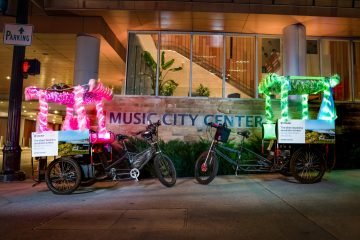
A pedicab wrap that works on Broadway is designed to read at a glance, from across the street, in the dim glow of neon signs at 10 p.m. That means bold colors with real contrast, a brand mark that doesn’t require squinting, and a visual concept simple enough to land in a photo taken by someone two drinks in on a Friday night. If it needs explanation, it needs a redesign.
The strongest campaigns treat the whole vehicle as the canvas. A logo slapped on a black background is technically an ad. A wrap that turns the pedicab into something visually cohesive and surprising is a photo opportunity. That distinction is what separates a placement from a shareable moment.
Adding an interactive layer compounds the effect. A branded hashtag printed where passengers can see it, a QR code that drops riders into a promotion, or even a small branded giveaway tied to the ride gives people a reason to post intentionally rather than just incidentally. Intentional posts are tracked, tagged, and traceable, which makes campaign attribution possible in a format where attribution is otherwise fuzzy.
Here’s a practical advantage worth noting: Nashville Bike Taxi’s pedicabs are already eye-catching on Broadway before any advertiser wraps them. You’re not starting from zero. You’re putting your brand on a platform people are already looking at.
That passenger pride is what drives the photo, which is the earned impression the rest of this piece builds on.
Beyond Advertising: Other Ways Nashville Bike Taxi Shows Up for Your Brand
A great wrap gets eyes on your brand. But the platform itself opens doors that go well beyond a single advertising placement.
Convention and corporate events are a natural fit. When a branded pedicab is running attendees between the Music City Center and nearby venues, every trip is a moving advertisement through downtown streets. The brand isn’t sitting on a wall waiting for someone to glance at it; it’s actively embedded in the event experience, trip after trip.
Group tours extend your geographic reach without any extra effort. A branded ride through Germantown, the Gulch, or East Nashville puts your logo in front of neighborhood audiences and local foot traffic that never sets foot on Broadway. One outing, multiple audiences.
Event-specific wraps take things a step further. Tying a wrap directly to a conference theme, a product launch, or a brand activation creates a cohesive experience where transportation and marketing feel like the same thing. Attendees aren’t being advertised to; they’re being hosted in a branded environment, which lands very differently.
That last point matters most for businesses entertaining out-of-town clients or guests. A branded pedicab experience is hospitality and advertising at the same time. Your guests get a memorable, fun way to move around the city. Your brand rides along for every moment of it. Almost no traditional outdoor format can do both simultaneously, and that combination is genuinely hard to replicate anywhere else in downtown Nashville.
The Takeaway for Brands Thinking About Advertising in Nashville
All of that adds up to one clear bottom line: if your goal is brand awareness and genuine audience interaction on Broadway, street-level mobile advertising makes a strong case for itself. That earned layer, organic posts from passengers and bystanders, is the structural difference between this format and anything fixed to a wall.
Static outdoor boards still have value, but Broadway is an environment where everyone is already pointing a camera at something. A format that puts your brand inside those photos, rather than hanging above them in the background, is a real strategic edge, not just a talking point.
Whether you’re a local business, an event planner coordinating a conference, or a convention organizer looking to make a bigger splash downtown, Nashville Bike Taxi is worth a conversation. Event transportation and group tours live alongside advertising partnerships on the same platform, which means your engagement can go well beyond a single wrapped ride.
The simplest way to approach the decision is this: figure out where your audience actually is and what they’re doing when your brand enters their field of view. Then ask whether a moving, photogenic, crowd-level platform rolling through the heart of Broadway serves that moment better than a fixed sign hanging above it. For most brands targeting the Broadway corridor, the honest answer points pretty clearly in one direction.
Conclusion
Broadway demands advertising that moves, earns attention, and lives inside the moments people are already capturing on their phones. Nashville Bike Taxi delivers exactly that: crowd-level visibility, organic social amplification, and cost-per-impression numbers that hold up under scrutiny.
The brands winning on Broadway are not waiting for audiences to look up. They are meeting people at eye level, on a platform that passengers photograph, share, and remember.
Ready to put your brand in motion? Reach out to Nashville Bike Taxi today and start a conversation about what an advertising partnership could look like for your business. The most photographed street in Nashville is already working for someone. Make sure it is working for you.